
On This Day: October 22, 1993 — Oasis Signs With Creation Records
Thirty-three years later, the Gallagher brothers are back on stadium stages together, and the paper McGee’s lawyers drew up that October still underwrites every reunion ticket sold. Oasis had exactly four songs worth playing when McGee first saw them. By the time the contract was signed, nothing about the deal was a sure bet — Creation was broke, the band had no finished album, and the whole thing rested on McGee’s gut instinct from one night in a 300-capacity Glasgow venue.
The Gig Nobody Invited Them To
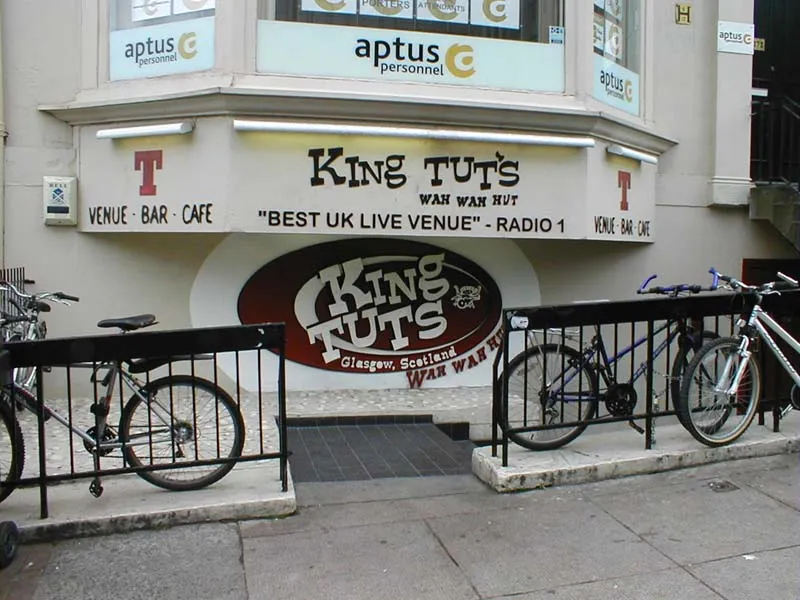
Oasis weren’t on the bill at King Tut’s Wah Wah Hut on May 31, 1993. A Manchester band called Sister Lovers had the slot, and Oasis tagged along because they shared rehearsal space with them, hoping to talk their way onto the stage. Noel Gallagher has since waved off the old story that they threatened to trash the place if they didn’t get a set — he’s called it “all bollocks” in later interviews — but however they got the opening slot, they got it, and they played four songs: “Rock ‘n’ Roll Star,” “Bring It On Down,” “Up in the Sky,” and a cover of the Beatles’ “I Am the Walrus.”
The Retro Almanac
A monthly roundup of "on this day" highlights from that month, decades back — plus first dibs on new retro merch drops. No spam, just the good stuff.
King Tut’s Wah Wah Hut in Glasgow, where roughly 30 people watched Oasis play the set that changed the band’s history.
Alan McGee, co-owner of Creation Records, wasn’t there to see Oasis. He’d come to watch another act entirely and happened to be standing in a room with maybe 30 people in it when a scruffy five-piece from Manchester he’d never heard of started playing. By his own account he knew within a song or two that he was watching something real, not just a competent bar band working through influences. He introduced himself to Noel Gallagher before the night was over and said he wanted to sign them.
Four Songs Was All McGee Needed
What happened next is the part of the story that’s been smoothed into legend, so it’s worth being precise about it: McGee offered Oasis a deal that night, but the actual contract took months to finalize. There was no album, no finished song list, and no American distribution lined up — Creation had to route the deal through Sony, which signed Oasis worldwide and then licensed the band back to Creation for the UK market. None of that paperwork existed yet in May. It existed by October.
The gap between the handshake and the signature matters because it’s where the real risk sat. McGee could have changed his mind. Oasis could have broken up, or signed somewhere else, or simply failed to write anything worth recording in the meantime. Bands get offered deals in sweaty rooms all the time; most of those offers evaporate before anyone picks up a pen. This one didn’t, and on October 22, 1993, it became official.
What That October Contract Actually Said
The terms were modest by major-label standards: six albums, a £40,000 advance split across the band, and a structure that gave Sony the global rights while Creation kept the UK. For a band with no commercial track record, £40,000 wasn’t an insult, but it also wasn’t the kind of money that buys loyalty if something bigger comes along. Oasis stayed anyway, and the six-album commitment ended up covering their entire original run together, from Definitely Maybe through to 2008’s Dig Out Your Soul before the band split the following year.
Noel Gallagher later became the band’s primary songwriter and the one driving the sound toward something bigger than the Madchester and shoegaze acts Creation had built its name on. Liam Gallagher’s voice gave that songwriting a sneer it needed. Whatever Creation’s lawyers thought they were buying in October 1993, what they actually got was a band that would outsell every other act on the label combined.
Creation Was Broke, and Oasis Was the Bet That Saved It
McGee wasn’t running a label with money to burn. Creation had built its reputation on the Jesus and Mary Chain and My Bloody Valentine, but it had also run up enough debt by 1992 that McGee sold half the company to Sony just to keep the lights on. Signing an unproven Manchester band for £40,000 in that financial position wasn’t a casual flourish — it was a gamble on the one thing McGee still trusted after years in the business: his own ear for a room going quiet when a band hits something real.
The bet paid off faster than anyone at Creation had a right to expect. If you want to see how a similar all-or-nothing instinct played out for a completely different kind of band rivalry, our Gene Simmons vs. Paul Stanley retrospective covers fifty years of two people betting everything on holding a band together despite hating each other.
Definitely Maybe Broke the UK Chart Record
Definitely Maybe came out on August 29, 1994, ten months after the Creation contract was signed, and went straight to number one. It went gold in four days and became the fastest-selling debut album in British chart history at that point, eventually certified ten times platinum. “Live Forever” gave the band its first proper hit single, and the album’s mix of Beatles-sized melodies and working-class swagger became the blueprint for the Britpop era that followed. Blur’s “Parklife” had already staked a claim on the same scene; Oasis answered with an album that didn’t sound interested in being clever about it.
The band’s own telling of this period got a full retelling two decades later in Mat Whitecross’s 2016 documentary “Supersonic,” built from unseen archive footage and the band members narrating their own rise. The film’s press tour put surviving members back in front of cameras together, years before anyone seriously expected the Gallaghers to share a stage again.

Liam Gallagher and founding guitarist Paul “Bonehead” Arthurs at the 2016 premiere of “Supersonic,” the documentary that retold the Creation Records signing in the band’s own words.
The Brothers Who Built It and Then Blew It Up
Oasis didn’t survive its own success cleanly. Noel and Liam Gallagher spent the next fifteen years fighting in public with roughly the same intensity they’d once aimed at music journalists who doubted them, and the band finally split backstage in Paris in August 2009 after an argument that reportedly involved a thrown guitar. Both brothers kept working. Noel formed Noel Gallagher’s High Flying Birds and leaned into a more measured, string-laced sound than anything Oasis had made. Liam fronted Beady Eye for a few years, then went solo in 2017 with a voice that hadn’t softened at all.

Noel Gallagher performing in Rome in 2012, three years into his post-Oasis career with the High Flying Birds.

Liam Gallagher at Rock im Park in 2017, the year his solo career began in earnest.
For sixteen years, neither brother gave much indication he’d share a stage with the other again. Fans who grew up on “Wonderwall” treated the split the way earlier generations treated other classic-band breakups — permanent, bitter, and not worth hoping about. If band rivalries that curdled into something personal are your thing, the Mötley Crüe story covers a different decade’s version of the same pattern: massive success, internal wreckage, and a long wait before anyone forgave anyone.
Sixteen Years Later, They Said Yes Again
In August 2024, Oasis announced what almost nobody had bet money on: a full reunion tour. The Gallaghers played their first show together in sixteen years on July 4, 2025, at Cardiff’s Principality Stadium, opening with 1995’s “Hello” in front of a sold-out crowd that had waited a decade and a half to hear it played live again. “It’s good to be back” rang out across the stadium, and for once, neither brother seemed interested in undercutting the moment with a jab at the other.
Oasis on stage at Principality Stadium in Cardiff, July 4, 2025 — the first night of the Live ’25 reunion tour.
The lineup around the Gallaghers filled in with founding rhythm guitarist Paul “Bonehead” Arthurs, longtime guitarist Gem Archer, bassist Andy Bell, and two new additions on drums and keyboards. Noel later told reporters his brother was “smashing it” on stage, which counts as a genuinely warm statement by Gallagher-to-Gallagher standards.
A Tour That Closed the Loop on the Creation Deal
The Live ’25 tour didn’t stay in the UK. After multiple nights in Manchester, London, Edinburgh, and Dublin, the band crossed into North America for stops in Toronto, Chicago, East Rutherford, and Los Angeles, then pushed on to Mexico City before closing the tour at São Paulo’s Estádio do Morumbi on November 23, 2025. Thirty-two years after a label with no money signed a band with no album, that same band was filling stadiums on four continents.

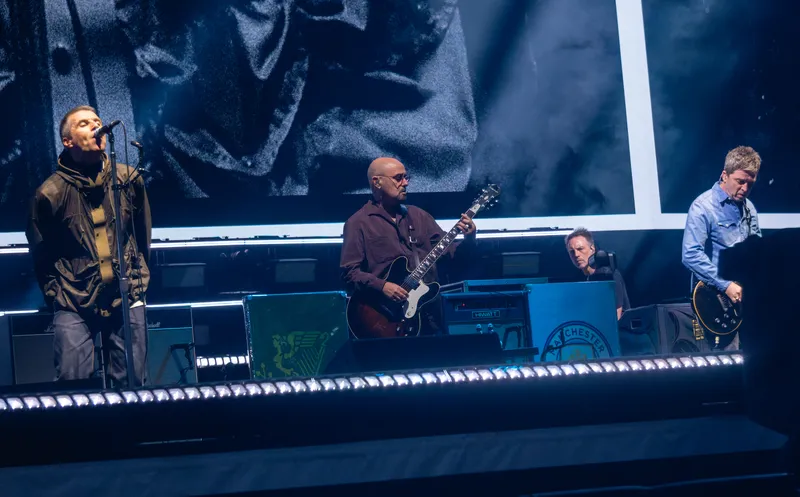
Oasis performing during the 2025 Live ’25 tour, more than three decades after the Creation Records contract that started it all.

A second angle from the Live ’25 tour, which carried Oasis through the UK, North America, and South America before closing in São Paulo.
None of it happens without the deal McGee’s lawyers typed up in October 1993. It’s easy to romanticize the King Tut’s gig as the moment that mattered, and it was a genuinely improbable break — a band that wasn’t even booked, playing in front of maybe 30 people, getting spotted by the one person in the room with a label and the nerve to act on instinct. But a verbal offer in a half-empty Glasgow venue doesn’t build a catalog. The signature five months later did that. If a-ha’s chart-topping breakout is more your era, our “Take On Me” retrospective covers a different decade’s instant arrival story.
Love the retro era? Browse our shop for vintage finds, retro clothing, and 80s/90s nostalgia gear.
Thirty-three years on, the contract signed that October is the quiet detail that makes the whole story work. Everyone remembers the gig. Almost nobody talks about the paperwork that turned a good night in Glasgow into a band that’s still selling out stadiums in 2025.
Sources
- Oasis — This Day in Music — Date and terms of the Creation Records signing.
- How Oasis were discovered in Glasgow — Glasgow World — Full account of the King Tut’s Wah Wah Hut gig.
- Definitely Maybe — Wikipedia — Chart performance and sales records for the 1994 debut album.
- Oasis Live ’25 Tour — Wikipedia — 2025 reunion tour dates, setlist, and lineup details.
The Retro Almanac
A monthly roundup of "on this day" highlights from that month, decades back — plus first dibs on new retro merch drops. No spam, just the good stuff.